
Brown Skin, Bright Light
Becoming My Own Revolution

Editor’s note:
Mikee’s submission arrives as our second piece in this new round of the Latinx Queer Chronicles. His writing carries power, memory, and the steady kind of honesty that comes from surviving more than most people will ever see. What he offers here is not just a story, but an offering, one shaped by community, lineage, and the long path back to himself.
I am grateful to hold this piece in our collection and honored that he trusted this space with a narrative that carries so much heart. May you find what you need in his words or simply take what speaks to you today.
Submissions for Latinx Queer Chronicles are open. We accept submissions in English, Spanish, and Spanglish.
If you are ready to share your story, please come and eat.
If you are not ready, that’s okay. I’ll make you a plate when you are.
Con cariño
Master Retro Bella
Brown Skin, Bright Light: Becoming My Own Revolution

I was born to a single mother who had already survived more lives than most people live in a century.
My mother left my Filipino father before I was born. He was violent, controlling, and cruel. She ended one pregnancy under his threats. She swore, “Never again.” I became her rebellion, her proof that she could choose life on her own terms.
She’s a lesbian. When my mother’s secret was forced into the light, everything changed. A relative outed her, and my grandparents kicked her out. She was homeless, pregnant with me. Another family member begged my grandparents to take her back, and they finally relented on one condition. She could return only because she was with child. I was her ticket home. I was also the reminder of her shame.
I didn’t have the words for “lesbian” then, but I knew. Other women lived with us, women who cooked with us or took me to soccer practice. I’d ask about my dad and she’d brush it off, vague and distant. By the time I was seven, the puzzle had already solved itself.
Being an only child made hiding easier. At family gatherings, while adults gossiped, I’d put on my headphones, play heavy metal, drift to corners, build universes in my head, imagine life where I could exist freely. My queerness lived safely there, in silence. I’d think about boys, but it was okay as long as it stayed locked in my skull.
The contradictions in my family’s words shaped everything I became. My grandparents prayed at church every Sunday but hurled whispers like knives at my mother. Their Catholic guilt and cultural pride created a rule in the house. You can be different, but never too different.
Those messages carved themselves into me. I learned early to shrink. To smile politely when adults joked about “those people.” To hide in white schools so no one would call me “beaner.” I was brown in a sea of beige and I felt it every single day. Kids mocked my skin, my food, my language. When I finally went to a school with more Latine kids, I still didn’t fit.
Not Mexican enough for the Mexicans.
Not Filipino enough for the Filipinos.
My earliest memories are the sound of lowrider engines rumbling at lowrider shows, the smell of carne asada drifting through the air. We didn’t have much, but we had rhythm. We didn’t always have enough food for the both of us, but we had music, community, and each other. My mom was an active gang member in South San Diego. People picture that and see danger, violence, something to be feared. But when she brought me home from the hospital, those same people filled the house to the brim to meet me. They brought gifts. She’d laugh and say most were probably stolen, but they brought love. Those were the people who helped raise me. They passed down street smarts, the ability to read a room before stepping into it, the instinct to survive no matter what.
Growing up, I was drawn to cholos. The way they stood, the tattoos that told stories, the fierce loyalty to la raza. In the lowrider community, everything was art. Every chrome line on a car was sacred geometry. I’d watch men airbrush Virgen de Guadalupe onto bikes, hear Chicano rap vibrating out of trunks, see Aztec dancers pounding the pavement, barefoot, with feathers that brushed the sky. It wasn’t just culture. It was church. People didn’t show off their cars to compete. They showed up to serve. Fundraisers, food drives, community car shows. Beauty used to build something bigger than ourselves.
When I was three, my mom took me to San Diego Pride. I don’t remember much, but every year after that, we went. Pride then wasn’t just one big corporate event. It was a festival and a constellation of smaller celebrations. Ebony Pride, Leather Pride, Latin Pride. I remember vaqueros slow dancing, Chicanas in hoop earrings kissing beneath palm trees, Cholos with tattoos and shaved heads holding hands, drag queens in gowns that twinkled brighter than sunlight. Mom would take me to Imperial Court events, where I’d watch Black and brown royalty crowned in rhinestones and applause. Those moments planted something holy in me, even if I didn’t yet understand what it was.
Still, at home, queerness was a curse. I learned that from the comments my family made when someone queer appeared on TV.
“Qué asco.”
“Eso no es normal.”
Each phrase pressed down on my chest like a hand reminding me to stay quiet.
By the time I reached high school, I was done suffocating. I attended a predominantly Latine school and immediately joined MEChA, Movimiento Estudiantil Chicanx de Aztlán, and the GSA, the Gay Straight Alliance. Between the two, I found oxygen. MEChA gave me back my brownness. GSA gave me back my queerness. For the first time, I didn’t feel like I had to trade one to keep the other.
Those meetings were electric. Posters of César Chávez and Frida Kahlo, trips to Chicano Park, conversations about intersectionality before we even knew the word for it. I learned about Aztlán, about resistance, about how every protest and poem was a form of love. I met queer Latine friends who taught me that we were part of a lineage of artists, activists, lovers, healers.
It was around that time I stopped caring what my family thought. The first spark of rebellion came from something so simple. A crush. A boy smiled at me, and everything cracked open. The real me clawed his way out of hiding and whispered, enough.
But freedom comes at a price. My family noticed the change before I ever said a word. The tone shifted, colder now. Questions turned to assumptions. When I was twenty, I went with my first serious boyfriend on a trip to Las Vegas with some straight friends. My grandmother called me. I mentioned who I was with, careful not to call him my boyfriend. She paused.
“Si eres joto, dime para matarme.”
If you’re a faggot, tell me so I can kill myself.
She hung up.
That sentence burned itself into my skin. I didn’t tell anyone for years. But it did something unexpected. It turned my fear into fuel. I realized silence wasn’t protecting me. It was protecting the systems that had hurt every queer person before me.
In 2008, when Proposition 8 passed in California, I was furious. How could they vote to take our rights and call it morality? I joined protests downtown, holding signs until my arms ached. I screamed until my throat went raw. That was the moment I became an activist. Not because I wanted to be, but because I couldn’t not be.
Over the years, I met elders who saw something in me. They’d nudge my mom and say, “Let him go, mija. Let him have fun.” They shared their own survival stories. Their first loves, their heartbreaks, the raids, the losses, the laughter that refused to die. Through them, I saw what it looked like to live openly, defiantly, joyfully.
And yet, life wasn’t linear. Addiction found me, too. Homelessness found me again. For a while, I became the ghost my younger self feared. Sleeping under bridges, using every day, selling my body just to survive, overdosing. There were moments I didn’t think I’d make it back. But the same empathy that always made me feel too much became my anchor. I couldn’t stop feeling for others, even when I wanted to disappear myself. That empathy was ancestral. I know that now. It was the voice of my ancestors saying, aguanta, mijo. Hold on.
Recovery isn’t a miracle for me. It is a war. But it was one that built me a solid foundation to grow. Step by shaky step, I started learning about my heritage again, both sides. Filipino warriors who fought colonizers barefoot. Mexican rebels who faced bullets with prayer. Queer ancestors who carved joy out of terror. They all live in me.
Sometimes I imagine speaking to them directly.
To my queer ancestors: thank you. I live and love out loud because of you. I refuse to hide again.
To my Filipino ancestors: I have so many questions. I want to know your stories, your laughter, your food, your battles. Teach me how you survived the impossible.
To my Mexican ancestors: from the warriors who lived a thousand years ago to the abuelas who prayed rosaries for safety, I carry your strength. I’ve learned that power isn’t about dominance. It is about compassion, about community, about choosing to heal when harm would be easier.
Now, I stand in rooms my younger self couldn’t imagine. I teach harm reduction, hand out Narcan, hug people others look away from, people who are treated as if they are subhuman. I guide meditations, teach yoga, host circles for queer and trans folks searching for peace. My past doesn’t haunt me anymore. It informs me. It keeps me honest and grounded.
I used to think I was broken. Now I know I’m mosaic. Every shattered piece of me reflecting light from somewhere sacred.
If I close my eyes, I can still hear the lowriders rumbling, smell the grease and sage, feel my mother’s hands on my cheek. I can see the little boy sobbing in a strange room after being taken by child welfare services, the teenager screaming in the streets, the addict whispering prayers in alleys, crying on all fours, voice shaking saying, “I need help.” All of them are me. All of them survived so I could stand here now, brown skin glowing beneath a sun that never asked me to apologize.
I am my mother’s revolution.
I am my ancestors’ answered prayer.
And I am my own bright light.
Letter to My Ancestors
You live in the drumbeat of my heart, in the smoke that curls from copal, in every person I hold when they’re shaking. You are the pulse in my palms when I place them over someone’s chest and say, breathe.
To those who were erased, I remember you.
To those who were silenced, I speak louder.
To those who died without seeing freedom, I live as proof that the fight was not in vain.
I will keep dancing in your honor, barefoot, in the rain if I must.
I will keep healing, even when it hurts.
I will keep becoming the light you dreamed of.
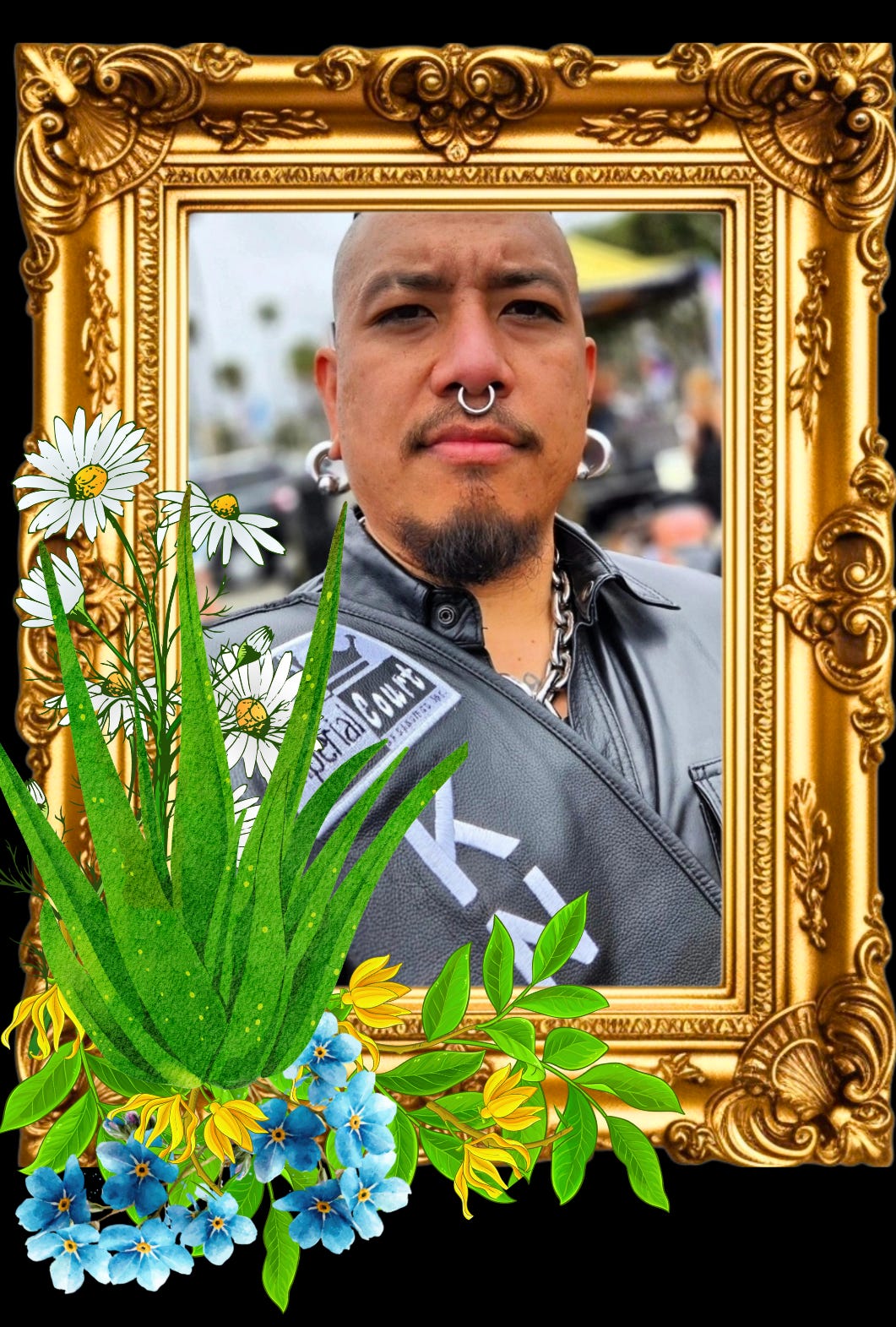
I don't have any words right now that seem appropriate. Just feelings. Thank you Mikee Vera for sharing your story in this beautifully crafted piece!
Mikee your love and brightness are a golden beacon to those who need your healing.